|
|
|
|
|
|
Introduction
Lingnan' or 'South of the Ranges' refers to that part of China to the south of the 'Five Ranges' which are Tayu, Qitian, Dupang, Mengzhu, Yuecheng. These ranges separate the river basin of Changjiang, or the Yangzi River, in the central part of China fr'om that of Zhujiang or the Pearl River, in the south. In the Tang dynasty (618-906) Lingnan was the official name for the area covering the provinces of Guangdong and Guangxi as well as Annan. The region covered by the name Lingnan has changed with time. Today, 'Ling"'nan' aod 'Guangdong' can almost be treated as synonyms.
Thus when we speak of 'Lingnan painting' today, we are referring to the work of painters in the Guangdong province in general. Strictly speaking, the two terms 'Lingnan painting' and 'Lingnan School painting' are not interchangeable. The 'Lingnan School' is only one of the many schools of painting in Lingnan, or Guangdong, and it should not be used to refer to painting of the Guaiigdong province as a whole.
Since late nineteenth century, the Lingnan School of painting has exerted tremendous influence on the painting development of the Lingnan area, so much so that it brought forth a new movement in Chinese painting in the first half of the twentieth century. This was the result of the heroic effort of Gao jianfu (1879-195 1), Gao Qifeng (1889.-1933) and Chen Shuren (1883-1948). The success of these three painters was so prominent that they are hailed,as the 'Three Masters of Lingnan'. To trace the early styles of the painting of the Lingnan School, we shall have to study the work of the famous flower painters, ju Lian (1828-1904), ju Chao (1811-1865), Song Guangbao (19th century) and Mengjinyi (19th century.
It is interesting to note how these masters were related to one another. Gao Qifeng learnt the art of painting from his elder brother Gao Jianfu. Two of the 'Three Masters of Lingnan', Gao Jianfu and Chen Shuren, were the students of ju Lian. Chen Shuren wasrecorded to be the last student of ju Lian, and their relationship was later further strengthened by the marriage of Chen
Guangbao and Meng jinyi and sought compromise between the opposite styles of the two masters. If Gao jianfu, Gao Qifeng and Chen Shuren were the major exponents of the Lingnan School, thenju Chao, ju Lian, Song Guangbao and Mengjinyi were the forerunners.
Both Song and Meng were not natives of Guang- dong. Song Guangbao, alias Outang, was a native of Changzhou district injiangsu province. He was noted for his painting of flowers and plants in a near-to-realistic manner in the style of Yuri Shouping (1633-1690), one of the Six Great Masters of Early Qing. Meng jinyi, alias Litang, was a native of Yanghu district, also in Jiangsu province. His bird-and-flower paintings were modelled after those of Chen Shen (1483-1544) of the Ming dynasty (1368-1644). Song and Meng were invited to Guangdong 4 painting teachers by Li Bingshou, a native of jiangxi,.-W!*,@ was appointed to an official post in Guangdong during the reign of Daoguang (1821-1850). These two masters soon established themselves as the leading bird-and-flower painters in the Lingnan district. Among those who followed their style of painting based .on the study of plant forms were the ju cousins.
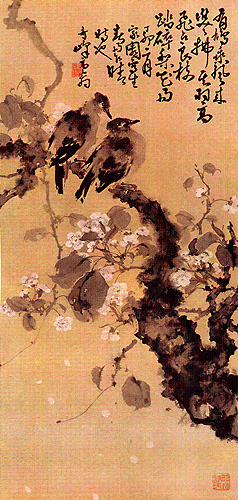
Ju Chao, alias Meisheng, pseudonym jinxianzhu, was a native of the Panyu district in Guangdong province. He was a versatile scholar noted for his painting, poetry and calligraphy. He was proficient in the painting Of birds, flowers, inscects, fish, landscapes and human figures. In the field of bird-and-flower painting, he was a master of the 'boneless technique'. His paintings on floral subjects have a touch of refine- ment which reveals his full mastery of his brush-work and colouring techniques, and his understanding of the system of growth of flowers and plants. with the niece of his teacher. On the other hand, ju Lian was the younger cousin ofju Chao. While ju Chao followed the painting style of Song Guangbao, ju Lian studied the paintings of both Song
ju Lian first learnt the art of painting from his cousin Ju Chao. Later he learnt from the works of Song Guangbao and Meng jinyi and those of earlier masters. He loved to paint flowers, plants and particularly insects which he kept in his garden. His. love- for painting insects made him the greatest insect painter in Guangdong. Although he took Song and Meng and other masters as his models in painting, he was not bound by the styles of anv of them. He succeeded in establishing a style of his own. His special colouring technique in which water and powder colour were skilfully applied to enrici tonal gradation and textural feeling of leaves and flower petals, and his emphasis on the importance of detailed study of objects in life laid down the basis on which the Lingnan Scho6i painting later developed. Among the early masters of the Lingnan School, ju Lian was by far the most influential of all.
The significance of the
contribution of Lingnan School painters in the development of Chinese
painting in the 20th century cannot be over- emphasized. To promote a
better understanding of the work of this important school of painting, the
Hong Kong Museum of Art of the Urban Council has engaged herself in a long
term exhibition project beginning with the presentation of the exhibition
of 'Kwangtung Painting' in 197 3 when a general survey of the different
schools of Guangdong paintings from the Ming dynasty to mid-20th century
was made. A similar exhibition called by the name 'Lingnan Painting' based
on the recent acquisitions of the Hong Kong Museum of Art to supplement
the 1973 survey was staged in 1976. It was followed by a series of three
one-man shows introducing the 'Three Masters of Lingnan School', Gao
jianfu, Chen Shuren and Gao Qifeng, in 1978, 1980 and 1982 respectively.
To bring our survey of Lingnan School masters up-to-date, two contemporary
painters of that Scitool in Hong Kong were introduced in out exhibition
series under the title 'The Art of Chao Shao-an' in 1979, and 'The Art of
Yang Shen-sum' in 1981. This is the tenth year since we first presented the 'Kwangtung Painting' exhibition in our gallery, and we take delight to mark our decade's effort in tracing the work of the Lingnan School by this exhibition which, we hope, may bring to light the artistic achievements of the forerunners of the school. |