|
|
||||||||||||||||||||||||||||||||||||||||||||||||||||||||
|
|
||||||||||||||||||||||||||||||||||||||||||||||||||||||||
| The Gentle Art of James Tan | ||||||||||||||||||||||||||||||||||||||||||||||||||||||||
|
SELECTED Articles | 0 | 1 | 2 | 3 | 4 |
Goodwood Park Hotel Journal
As a boy, he would spend most of his leisure time attending art exhibitions and browsing around second- hand book stores; intent on deepening his awareness of the art.
The members of James' traditionally-minded, conservative family had mixed reactions to his wanting to be an artist. His father and a brother encouraged him while the rest doubted the earnestness of his intention. But the more he was discouraged, the greater was the urge to prove his artistic abilities and to gain financial independence through this profession.
In his early teens, James had already set his mind on a particular style of brush painting ? the Lingnan style which created scenes with a living quality. He read widely on Lingnan painting and he even enrolled himself on a correspondence course conducted by a famous Lingnan artist from Taiwan. However, he found it very difficult to master the technique through correspondence; so, regretfully he withdrew from the course.
From then, James was left to try to master the technique on his own, until he chanced a meeting with a renowned Lingnan master, Wong Lui-Sang at an exhibition. This resourceful young man offered Huang his service as an assistant while receiving tutelage from the master.
For the ensuing six years, James was to study, practice and improve his technique under the master's guidance ?a rare privilege indeed for a young artist just starting out. In fact, he even traveled to San Francisco with his master during this time.
"The Lingnan School was started by a group of Cantonese artists in China." said James. "They used Chinese art techniques, but because these masters traveled widely, they were influenced by Japanese and American styles. They tended to deviate from the original Chinese art form by introducing new subjects, themes and ideas. In time, a distinct style evolved."
What impressed James most was the way modern art ideas were being incorporated with the ancient practices. Even abstract art, something virtually unheard of in Chinese art, was accepted by the Lingnan School.
Furthermore, while traditional Chinese compositions tend to use more black, grey and white tones, Lingnan art, on the other hand, will keep closely with the original ?and therefore more natural-colors. To James, this is very important as natural colors create a sense of animation in the painting.
"In the beginning. I just painted what I thought was right," said James, "but when I observed life and com- pared it with my works, I found that I was wrong to have assumed the behaviors of my subjects. I had not under- stood them well enough to make them look real. Now I make sure I study what I want to draw so that I don't make mistakes."
As he mastered the intricacies of Lingnan brush- work, he developed his own unique philosophies: "I like the contemporary spirit in my paintings; I like to keep my work up to date. So when I visit exhibitions, I always look out for revolutionary trends and try to analyze the factors that cause artists to adopt changes in their art." In this way, James is able to fulfill his desire of perpetual self-improvement. He found himself maturing, not just due to the natural passage of time but because he persevered towards that goal.
James no longer confines himself to using traditional Chinese'-brushes. He paints equally well with any type of paintbrush.
"It is not the type of brush you use; it's the technique that's important. It's also how you handle and control your brush." says James.
"My compositions always focus on quietness, peace freedom and romance. I would love to see beauty and happiness in this world." he said. "As far as possible people should avoid being bogged down by problems. And for an artist, I consider it very important to view beauty as an essence of life."
And so it was with that conviction that he created such works as "Carefree" 'After Rain' in which James attempts to bring Nature's benevolence to light. The former depicts five carps merrily, yet gracefully weaving among the weeds, without anxiety or fear. 'After Rain' captures a romantic scene of two little birds enjoying the cool, clean air after shower of rain.
Although his paintings are expressive of a certain mood or emotion. James realizes that interpretation can differ widely from person to person. Others may not see a niece of work the way he had intended it to be, but that is acceptable to him.
Turning to his more unconventional pieces, Waterfall' and 'Expression', he said: "Right now, I don't believe in painting a picture that immediately reveals the composition I paint my feelings and allow the appreciative eye to interpret my works according to what they see.
It is clear that this concept is adopted from the Lingnan School which does not advocate a dogmatic approach to style and technique. Lingnan artist's support the modernizations of traditional brushwork and suggests that the artist grows with his art. With other artists and, even compete in order to .stand out prominently.
Perhaps this is the very principle that motivates James to forge ahead of many of his contemporaries. Although he may look boyish and unassuming and appear satisfied with his lot. James has an iron will and the necessary discipline to develop his talent to the fullest. In September this year, one of James abstract painting, entitled "Bay" won him a Certificate of Distinction from United Overseas Bank Group s Fourth Painting of the Year competition. 'Bay is a captivating and interesting blend of the themes of solitude and freedom.
Still, this artist does not selfishly guard his skill - James conducts classes and demonstrations to art enthusiasts At the same time, he is aspiring towards a long-overdue dream of setting up an art gallery that will feature fine works of art. He would like to donate e such a museum to the country for it to become a cultural centre that educates the public on the appreciation of true beauty in art. James Tan is one of a rare breed of Chinese artists who have dared to venture beyond the traditional norm to create new images and yet keep the valued technique of fine strokes and delicate effects in traditional Chinese paintings
|
||||||||||||||||||||||||||||||||||||||||||||||||||||||||
|
| BIOGRAPHY | ARTICLES | GALLERY | EVENTS | RECENT WORKS | ART COURSE | |
||||||||||||||||||||||||||||||||||||||||||||||||||||||||
|
||||||||||||||||||||||||||||||||||||||||||||||||||||||||



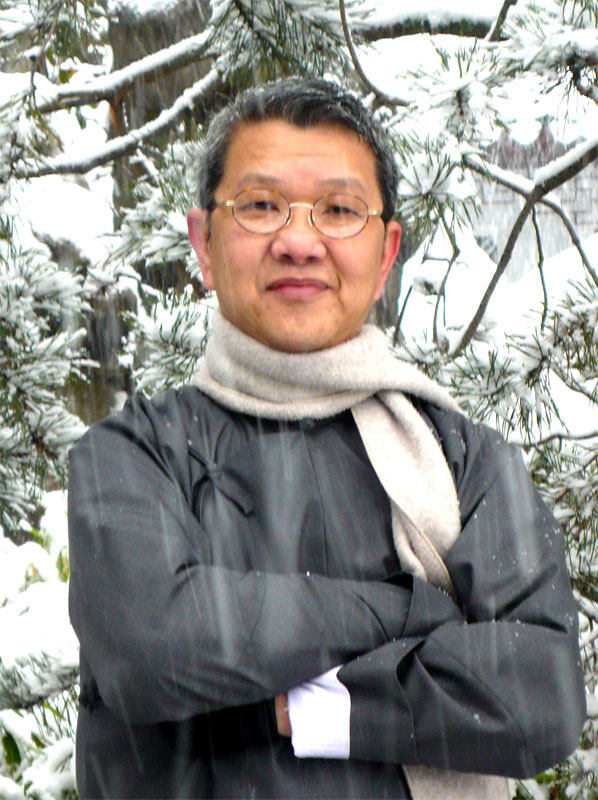 James
Tan still remembers how it felt to be young, poor and hungry for the
knowledge of Chinese art.
James
Tan still remembers how it felt to be young, poor and hungry for the
knowledge of Chinese art.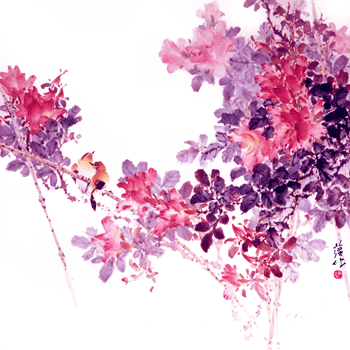 To paint his subjects as authentic to their original form as possible,
James spends time studying carefully every subject he intends to paint. He
now knows how lotuses and peonies unfold their petals; how carps and
goldfish meander, even the difference between the way sparrows and
thrushes fly is noted by him
To paint his subjects as authentic to their original form as possible,
James spends time studying carefully every subject he intends to paint. He
now knows how lotuses and peonies unfold their petals; how carps and
goldfish meander, even the difference between the way sparrows and
thrushes fly is noted by him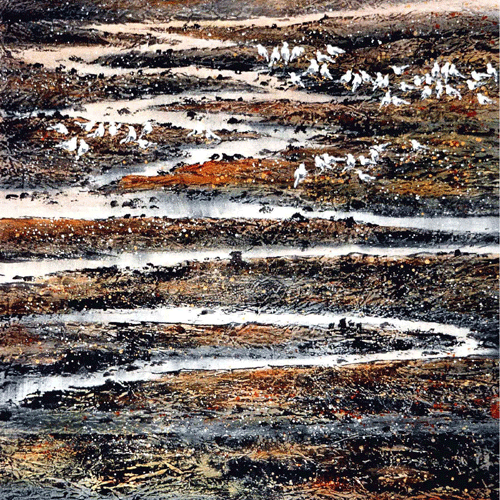 His compositions also bear certain characteristics reflective of his
lifestyle and personal beliefs. If we had to use just one word to
describe. James works; it would be 'tranquility': none of his paintings
have any evidence of fuss or confusion.
His compositions also bear certain characteristics reflective of his
lifestyle and personal beliefs. If we had to use just one word to
describe. James works; it would be 'tranquility': none of his paintings
have any evidence of fuss or confusion.


