Art / World-famous brush painter exhibits in
Chinatown
story by CE Gatchalian Xtra! West Oct 16 2003
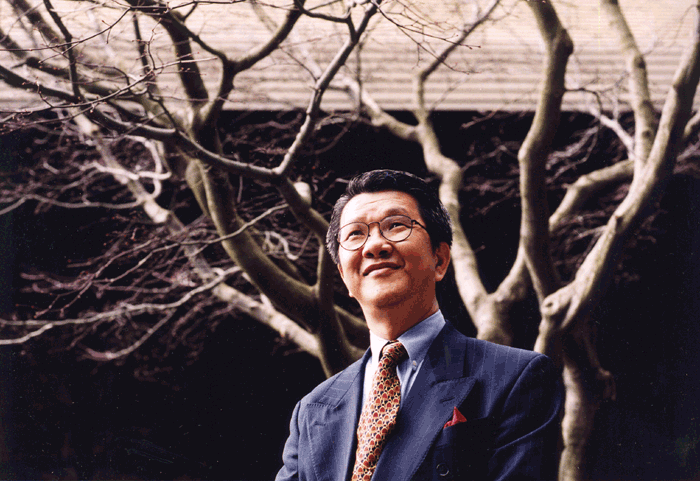 When
taking in the turbulent yet exquisite paintings of James Tan, one word
comes to mind more than any other: harmony. When
taking in the turbulent yet exquisite paintings of James Tan, one word
comes to mind more than any other: harmony.
The harmony, that is, of two distinct artistic styles: the delicacy and
rigour of traditional Chinese painting, and the freedom and individualism
of Western art.
This fusion, a defining feature of Tan’s work, is in concord with how the
artist has divided his life between Asia and North America. He was born in
Malaysia, studied art in Singapore, moved to San Francisco in the 1970s
where he opened his own gallery, moved back to Singapore, and since 2001
has resided in Vancouver, where he operates his anonymously named gallery
in Chinatown and lives with his partner, Dr John Giffen.
Tan’s art is rooted in what is known as the Lingnan School of Chinese
painting, which combines traditional Chinese brushwork with Western
innovations such as wider color palettes and greater freedom of emotional
expression. But Tan often takes the “Western” part of his style to the
limit, displaying an abstract expressionism reminiscent of Kandinsky and
Pollock.
“Chinese painting should not be just plum blossoms, bamboo, and
mountains,” says Tan. “Contemporary painting gives me the chance to
explore and to expose myself to a new world where what matters is image
and emotions, not subject matter.”
Tan is regarded as one of the foremost Chinese brush painters in the
world. He has had 37 solo exhibitions, and his work hangs in museums,
government organizations, banks and hotels around the world.
The Glass Hotel in Singapore ordered 1,000 of his paintings. The Emir of
Bahrain owns an original in his private collection.
Not bad for the youngest child of a rubber estate caretaker.
Tan is modest about his enormous success. “I am happy people like my work.
I am happy that it sells. But it does not mean a lot to me whether my work
sells or not. I am more focused on the quality of my work than on selling
paintings.”
But neither does he betray false modesty when asked whether he is
surprised by it. “No. Because of all the hard work that I put into it, I
knew I would [be successful], so no, it doesn’t surprise me at all.”
What may come as a surprise to many people is what he has to say about
Singapore, the country where he studied his craft and spent most of his
life. Contrary to the popular conception of it as a hostile and oppressive
country, Singapore, Tan says, “is actually very open [about gay issues].
You can say that it’s difficult to be a gay man there if you’re in the
closet. But if you open up about yourself it is not hard at all, because
Singapore is an open society. The Singaporean government has just promoted
a homosexual to a top job. People don’t really care whether you’re a
homosexual or straight.”
The story of how he ended up in Vancouver is a touching one. “I was
planning for a round-the-world trip, and I had never been to Canada,” he
says. “I went to Toronto, Calgary and Vancouver. I was looking for
friends, so I put an ad on the Internet. And my partner today, John,
answered my ad. So after that we did a little correspondence, and I told
him that I would be in Vancouver in June 1999. After we met, we found out
that we were very fond of each other. So we started planning our
relationship. It’s not an easy job to be in a relationship, but so far,”
he adds with a chuckle, “it’s been good.
Articles from Xtra! West
http://www.xtra.ca


|





